

INFORMATION TECHNOLOGY DIVISION
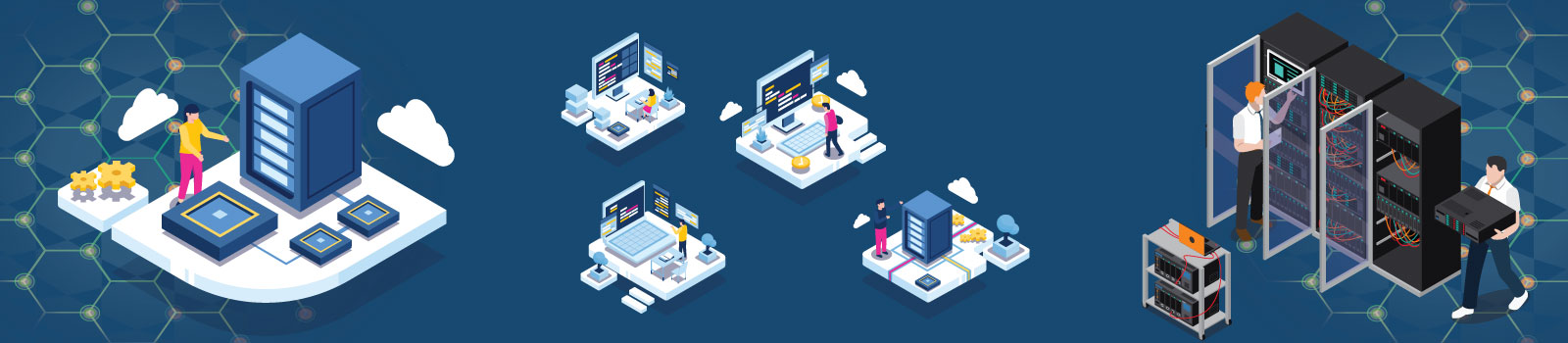
The Office of the Registrar General & Census Commissioner, India (ORGI) has played a pivotal role in conducting the decennial Census of India since 1961. As census operations have grown in scale and complexity, technology has become essential to their effective execution. The Information Technology (IT) Division serves as the technological backbone of ORGI and is responsible for designing, developing, and maintaining the digital systems that support census operations. It oversees data processing and management, safeguards the organisation’s IT infrastructure and data, and ensures reliability, efficiency, and accuracy of its systems. Through these functions, the IT Division supports the gradual modernisation of census operations by improving digital processes and enabling the secure and efficient collection, processing, analysis, and dissemination of critical demographic information. Its efforts strengthen ORGI’s technological capabilities and support the effective fulfilment of its national mandate.
2027 Census
The Census of India 2027 marks a historical milestone as the country adopts fully digital data collection for the first time. Building on its continued use of modern technology in census operations, this transformation will streamline the collection, processing, and dissemination of data. Under the Bring Your Own Device (BYOD) model, enumerators will use their Android or IOS smartphones to record information through mobile applications developed at ORGI. The shift is expected to improve operational efficiency, enhance data quality, and strengthen the technological foundation of census operations.
The broad outline of the methodology is as follows:
-
Data Collection is being done through the following two modes:- :
- Self Enumeration: The general public will be able to submit their information independently at a place of their convenience.
- Mobile Application Based: Enumerators will conduct field visits to every household and collect the required information using mobile applications to ensure comprehensive and accurate data collection.
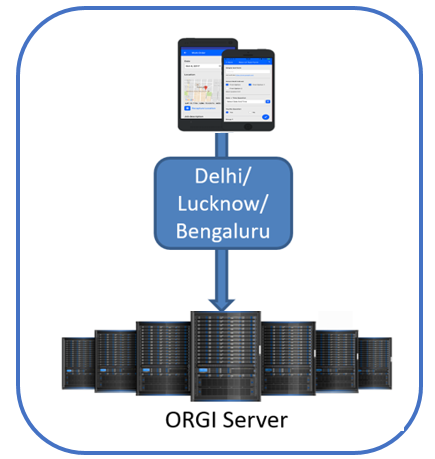
(Data collected through both self-enumeration and mobile applications will be automatically transmitted by the system to any one of the three Data Centers of ORGI located at Delhi, Lucknow and Bengaluru. Data from both SE and mobile applications will be automatically transferred to ORGI’s three data centres, with automatic failover and daily incremental backups to ensure data availability and continuity. Self-enumeration will generate a unique SEID to enable data retrieval by enumerators during household visits. Retrieved data will be auto-populated on enumerators’ devices for verification and completion. )
Management & Monitoring through Census web portal (CMMS):
The Census Management and Monitoring System (CMMS) is a unique web-based initiative established to manage, coordinate, and monitor all preparatory and ongoing Census activities in real time. It maintains a comprehensive location particulars for all administrative areas across the country and serves as a centralized repository for information relating to the appointment of census functionaries, training programmes, work allocation, logistics, fieldwork progress, and the online entry of consolidated abstracts, among other operational activities. By integrating these functions into a single platform, CMMS enables systematic coordination, efficient supervision, and timely monitoring of Census operations throughout the entire census process.
Data Security:
Robust security measures has been implemented at every stage of the data lifecycle- from collection and transmission to storage and processing within the ORGI servers. These measures are designed to safeguard data, prevent unauthorized access, and ensure its confidentiality, integrity, and availability :-
- Authorized Access: Data is collected only by duly identified and authorized users, with clearly defined access levels and permissions to ensure that only authorized personnel can access the data.
- Multi- Layered Security: A multi-level layered security approach is adopted to protect data on mobile devices, during transmission, and while stored, providing protection at every stage of the data lifecycle.
- Secure Data Storage on Mobile Devices: Collected data is encrypted before being saved on mobile devices, with appropriate date and time stamps to support traceability and accountability.
- Automatic Data Removal: Once Data has been successfully transmitted to the ORGI Server, it is automatically removed from the mobile device after a predefined period, reducing the risk of unauthorized access or data exposure.
- Comprehensive Audit Trails: Detailed logs of data access and related activities are maintained to support monitoring, traceability, accountability, and security audits.
- Encryption of Data at Rest and During Processing: Data stored on ORGI servers is maintained in encrypted form. Decryption is performed in memory, as required for processing, and the data is not retained in decrypted form for user access once processing is complete.
- Backup and Disaster Recovery: To ensure data safety and business continuity during unforeseen events, servers and storage systems used for data processing and secure storage are deployed across three data centres located in Delhi, Bengaluru, and Lucknow. This distributed infrastructure supports data protection, backup, and disaster recovery.
- Advanced Security Monitoring and Threat Prevention: To protect ORGI Data Centres and their information assets against threats such as volumetric attacks, network intrusions, SQL injection, cross-site scripting (XSS), data leakage and unauthorized access, ORGI has planned the establishment of a dedicated Security Operations Centre (SOC) and Security Information and Event Management (SIEM) capabilities at all three data centres, supported by appropriate hardware and software security appliances .
Through these comprehensive measures, ORGI aims to maintain a secure, resilient, and reliable data environment while protecting sensitive information throughout its lifetime.
2011 Census
Technology Options for Census 2011 IT resources were created at 18 data centres by installing 36 Nos Microsoft Windows 2008R2 servers, SQL Server -2008, Windows 7 Professional Clients, High speed heavy duty duplex scanners (Kodak) and backup HP Storage Works EVA6400, Capacity – 10/100 TB. In addition to above Hardware & Software an Intelligent Character Recognition (ICR) software eFlow4.5 has also been installed to meet the challenges of Census-2011. About 1200 technical officers and about 500 contractual operators were engaged for electronically data capturing at 18 data centres and processing of census data at DP Division, New Delhi.The use of ICR technology after scanning the schedules and use of Computer Assisted Coding (CAC) saves a lot of Government expenditure incurred in the past on setting up of Regional Tabulation Offices. The services of a System Integrator were utilized at 18 Data Centres for scanning operations and data file creation. All the required software & MIS tools are developed by the officers of Data Processing Division, ORGI, New Delhi.
-
Following Server Hardware and storage has been installed in D.P. Division and in 18 Nos Data Centers in India for data processing activities- :
- HP ProLiant DL380G6 Quad Core Base Servers
- HP Storage Works EVA6400, Capacity – 10/100 TB
- Kodak High Speed Scanners
2001 Census
At 2001 census, large scale hardware up-gradation had been made at 15 Data Centres and in DP Division, New Delhi. This was required for using the latest “Automatic Form Processing Technology" using “Intelligent Character Recognition (ICR)” technology. The OMR/OCR/ICR technologies were evaluated and ICR was found to be acceptable being the viable solution for census data processing activities. IT resources were created at 15 data centres by installing 45 NT servers, 1060 PIII PCs, 25 High speed heavy duty duplex scanners (Kodak) and used backup devices like ZIP SLR & DLT drives. In addition to above Hardware & Software, an Intelligent Character Recognition (ICR) software eFlow has also been introduced and installed for the first time to meet the challenges of Census-2001. About 1200 technical officers and about 500 contractual operators were engaged for electronically data capturing at 15 data centres and processing of census data at DP Division, HQr., ORGI, New Delhi. The paper schedules were transported to the nearest allotted data center (resulted in reduced transportation cost) for scanning and data file creation activities. The scanning activities were carried out on 24x7x30 basis. The technology enabled processing of cent percent data, that is, more than one billion records (228 million paper forms were scanned) for the first time in census history. The scanned images were archived for permanent storage. Image enabled Computer Assisted Coding (CAC) was applied for certain fields. The use of ICR technology after scanning the schedules and use of CAC (eliminated setting up of Regional Tabulation Centres for manual coding) saved the Government lot of expenses incurred in the past on setting up of Regional Tabulation Offices. The services of a System Integrator were utilised at 15 Data Centres for scanning operations and data file creation. The use of technology has helped to enhance the skills of EDP officers of ORGI. The DP Division officers have developed the data processing software in-house.
-
The DP Division has assisted various Technical Divisions of ORGI for data processing projects, such as:
- Preparation of District Hand Book ( Social Studies Division)
- Large size village study data entry and processing (Social Studies Division)
- Extraction of data from 2001 census data and tabulation for slum project (Census Division)
- Scanning and ICR based processing for Verbal Autopsy (Vital Statistics Division)
- Scanning and ICR based processing for 5th Economic Census of Central Statistical Organisation.
1991 Census
During 1991 Census, a drastic change in the data processing activities in ORGI was taken place. ORGI had setup its own computing facility by installing Medha-930 main frame system at DP Division, Pushpa Bhawan. Dumb terminals, under Unix operating system, connected to the servers at 15 data centres, were used for data entry. Data movement between various data centers and Computer centre at Delhi was done through magnetic tapes. The data schedules were coded at various regional tabulation centres (about 163) throughout India before sending the schedules to the allotted one of the 15 data centres for data entry. Master data files creation, data editing on basic fields and lower level tabulations were processed at 4 Regional Processing Centres namely Delhi, Bhopal (Madhya Pradesh), Bhubaneshwar (Orissa) and Chennai (Tamil Nadu). Major editing considering all the fields, processing and generation of all the tables at various levels were taken up in DP Division, ORGI, HQr. All the required software (for data validation, editing, processing and tabulation) were developed by the officers of Data Processing Division, ORGI, HQr. First time, in the 1991 census, DP Division generated the camera ready copies of the tabulations in Hindi as well as in English for publication. The cent percent data was captured. The processing was done on the cent percent data of workers & SC/ST. Only 10 per cent records were processed for other tabulations. Around 1200 ORGI officers including officers at 15 data centres were engaged for the entire census data processing activities. The software were developed in-house by DP Division officers.
1981 Census
In 1981 Census, first time in Indian census, the data entry activities were decentralised and 15 data centres were setup in major states including one at headquarters, ORGI. Each centre was allotted more than one state (adjoining states) to convert paper-based information into machine-readable form using “key to disk” machines provided by GCS, ECIL & ICT. The data processing was done using HP1000, CD-Cyber 730 & NEC-1000 computer systems at NIC, New Delhi and Regional Computer Centre (RCC), Chandigarh. The in-house data processing facilities were not available in ORGI. The data schedules were coded at various regional tabulation centres throughout India before sending the schedules for data entry to allotted one of the 15 data centres. Around 1200 ORGI officers including officers at 15 data centres, were engaged for the entire census data processing activities. All the required software (for data validation, editing, processing and tabulation) were developed by the officers of Data Processing Division, ORGI, Headquarters.
1971 Census
Census 1971 was the 11th in the continuous series of censuses since 1872. It is well-known that the processing of the census data occupies a very important place in the census. The census enumeration may be thorough and accurate but the census tabulation will not be accurate and useful unless the raw data are properly processed. There are various methods of data processing and the choice of a suitable method depends upon the circumstances of the country. In 1971 census, most of the tables were prepared from a 10 percent sample of the rural population and a 20 percent sample of the urban population, with the help of electronic computers, mainly IBM-1401s.
1961 Census
In 1961 census, a modest beginning was made with the adoption of “Unit record” machines. Prior to 1961 censuses, the data collection, data entry and processing were done manually. In 1961 census, the Hand Punching machines (inserting one card at a time) using 80 column (Hollerith) punch cards were used for converting data into machine readable form. The processing was done on the sample (data) selected from the entire data. Around 70 ORGI officers were involved in the data entry, programming & machine operations. The data schedules were coded at various regional tabulation centres throughout India before sending the schedules for data entry. Reproducer was used to duplicate the entire set of punched cards. Data Processing was done by using Verifiers, sorter machines. “Serial Rolling Total Tabulator cum printer (SRTT)” was used for tabulation and printing of census tables. Data backup system was not available at that time.


 : 5634341